Resilience Interventions in Northeastern Nigeria: Insights from a Research Workshop with NGO Staff in Maiduguri
Written by Imrana Buba
In the humanitarian world, few terms are as ubiquitous and as misunderstood as “resilience.” It conveys hope: the idea that communities devastated by war, displacement, or disaster can recover and rebuild. In Northeastern Nigeria, where Boko Haram has battled the Nigerian state for over a decade, international donors and NGOs have embraced resilience programming, particularly in Borno, Adamawa, and Yobe states. With government services largely absent or unreliable in many conflict-affected areas, NGOs have taken the lead in implementing projects aimed at “building social resilience.”
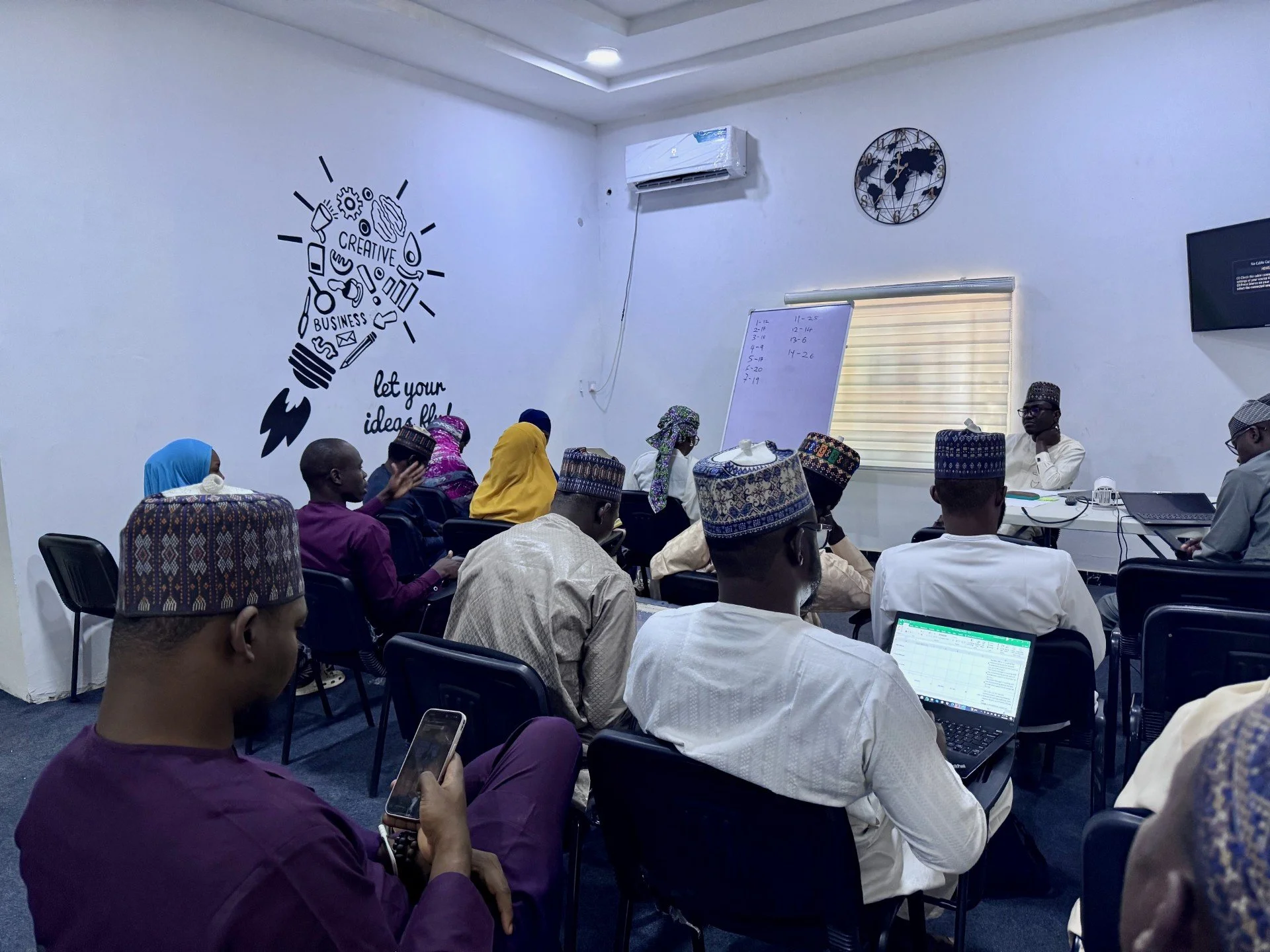
In January 2025, as part of my doctoral research, I conducted fieldwork in Borno state, the epicenter of the Boko Haram insurgency. Given the security challenges and logistical hurdles of accessing many of the communities where I conduct research, I typically begin with unstructured interviews and a few targeted focus group discussions. These initial conversations help refine my data collection approach and inform case selection. This time, I organized a small workshop with NGO professionals responsible for implementing these programs to prepare research into how civilians shape resilience interventions.
Partnering with the youth-led organization Xpeace Associates for logistical support, I hosted a discussion that brought together 22 Nigerian staff from international NGOs and UN agencies (including project officers, project coordinators, and consultants), as well as local NGO managers and directors, most of them from Borno State. The workshop was guided by a central question: How do resiliencebuilding programs work in practice in Borno State, and what do they change for local communities?
Participants understood ‘resilience’ to mean broadly the ability of individuals and communities to adapt, recover, and thrive after adversity. The interventions ranged from economic recovery and education to psychosocial support and climate adaptation. UN agencies and international NGOs typically provide funding and technical expertise, while state governments and local NGOs implement projects directly. Key efforts include rebuilding infrastructure, supporting livelihoods, and addressing educational disruptions. Interventions are designed to counter Boko Haram violence, recruitment, and territorial control. For instance, livelihood programs, such as small-scale farming or briquette-making, aim to provide alternative incomes while reducing reliance on wood collection in insecure areas. Education initiatives focus on re-engaging out-of-school children to prevent their recruitment into insurgent ranks.
A central theme of the discussion was the role of traditional and community-based structures in shaping resilience programming. Participants emphasized that successful interventions depend on local leaders’ involvement to ensure community ownership and sustainability. However, working within existing structures also presents challenges. Some participants noted that relying solely on traditional leaders in project planning often sparks complaints from beneficiaries, who perceive them as corrupt or disconnected from the people. Others shared instances where traditional leaders sought to monopolize interventions, selecting their relatives that did not meet criteria or prioritizing their interests over broader community needs. Additionally, tensions between high-ranking traditional leaders and lower-level representatives, such as bulamas, can hinder program effectiveness. To navigate these challenges, NGOs increasingly establish community committees that include not only traditional leaders but also youth leaders, women leaders, businesspeople, imams, pastors, and representatives of minority ethnic groups.
A recurring concern was the difficulty of operating outside the military’s “Super Camp” strategy. Since 2019, the Nigerian military consolidated civilians into garrison towns under its protection, leaving vast rural areas with minimal security presence and little tolerance for humanitarian activity. As one participant put it, “Anything we do outside the camps is seen as a threat [to the military].” Even travel between Super Camps was risky, forcing NGOs to rely on helicopters or contract local transport companies under military escort. This system, while providing security, significantly inflated logistical costs, diverting funds from direct interventions. The result was a shrinking humanitarian space: aid organizations were largely confined to “secure” towns such as Maiduguri, Biu, Bama, Jere, and Mafa, while communities outside these enclaves were left to fend for themselves, often by negotiating with insurgents.
The workshop underscored the need for a fundamental rethinking of ‘resilience’ in both research and policy circles. Too often, resilience is treated as a neutral, technical concept, measured through metrics and toolkits. But as this discussion revealed, resilience is deeply political. Where aid is allowed to go, who receives support, and what forms of recovery are prioritized are shaped by power dynamics, not just humanitarian need. Policymakers and researchers must grapple with these realities, asking not only how resilience is built, but under whose terms, and at what cost.